The Swift Reboost Mission
The Daring Rescue in Low Earth Orbit: The Swift Reboost Mission
A historic, race-against-the-clock commercial mission has launched to save one of NASA's most legendary space telescopes from a fiery demise.
On Friday, July 3, 2026, history was quietly made high above the Pacific Ocean. An air-launched Northrop Grumman Pegasus XL rocket completed its final historic flight, sending a small, specialized commercial robotic satellite named LINK into the heavens. Its destination? A high-stakes rendezvous with the multi-million dollar Neil Gehrels Swift Observatory, an iconic piece of NASA space infrastructure that is currently falling toward Earth.
The Problem: A Falling Legend
Launched in 2004, the Swift Observatory has spent over two decades serving as astrophysics' premier "first responder." It scans the cosmos to detect Gamma-Ray Bursts (GRBs)—the most violent explosions in the universe since the Big Bang. Swift detects about a hundred of these deep-space explosions a year, pointing its powerful instruments toward them within seconds before they fade away.
However, Swift has a major vulnerability: it has no propulsion system of its own.
Over twenty-two years, atmospheric drag has gradually lowered Swift's orbit from 600 kilometers down to roughly 400 kilometers (250 miles). Making matters worse, recent intense solar activity expanded Earth's upper atmosphere, rapidly accelerating Swift's orbital decay. Without intervention, scientists calculated that the telescope would undergo an uncontrolled, destructive atmospheric reentry by the end of 2026.
Race Against the Clock
"Given how quickly Swift's orbit is decaying, we are in a race against the clock to save it," stated Shawn Domagal-Goldman, a top NASA astrophysics official. If Swift falls below a critical threshold of ~300 kilometers, the atmospheric drag will become too violent for any servicing vehicle to safely dock.
The Savior: Enter the LINK Spacecraft
Instead of letting the productive telescope burn up, NASA pivoted toward a daring, highly affordable solution. In September 2025, the agency awarded a $30 million contract to Flagstaff, Arizona-based Katalyst Space Technologies to orchestrate an unprecedented rescue mission.
Katalyst's answer is LINK—an 880-pound (400 kg) small satellite built and tested in a record-breaking eight months. On July 3, 2026, LINK successfully separated from its rocket, and ground teams have already established steady communication with the vehicle.
The Mechanics of an Orbital Tow Truck
Because Swift was built over two decades ago, it was never designed to be serviced or docked with in space. This makes the upcoming operational phases incredibly complex:
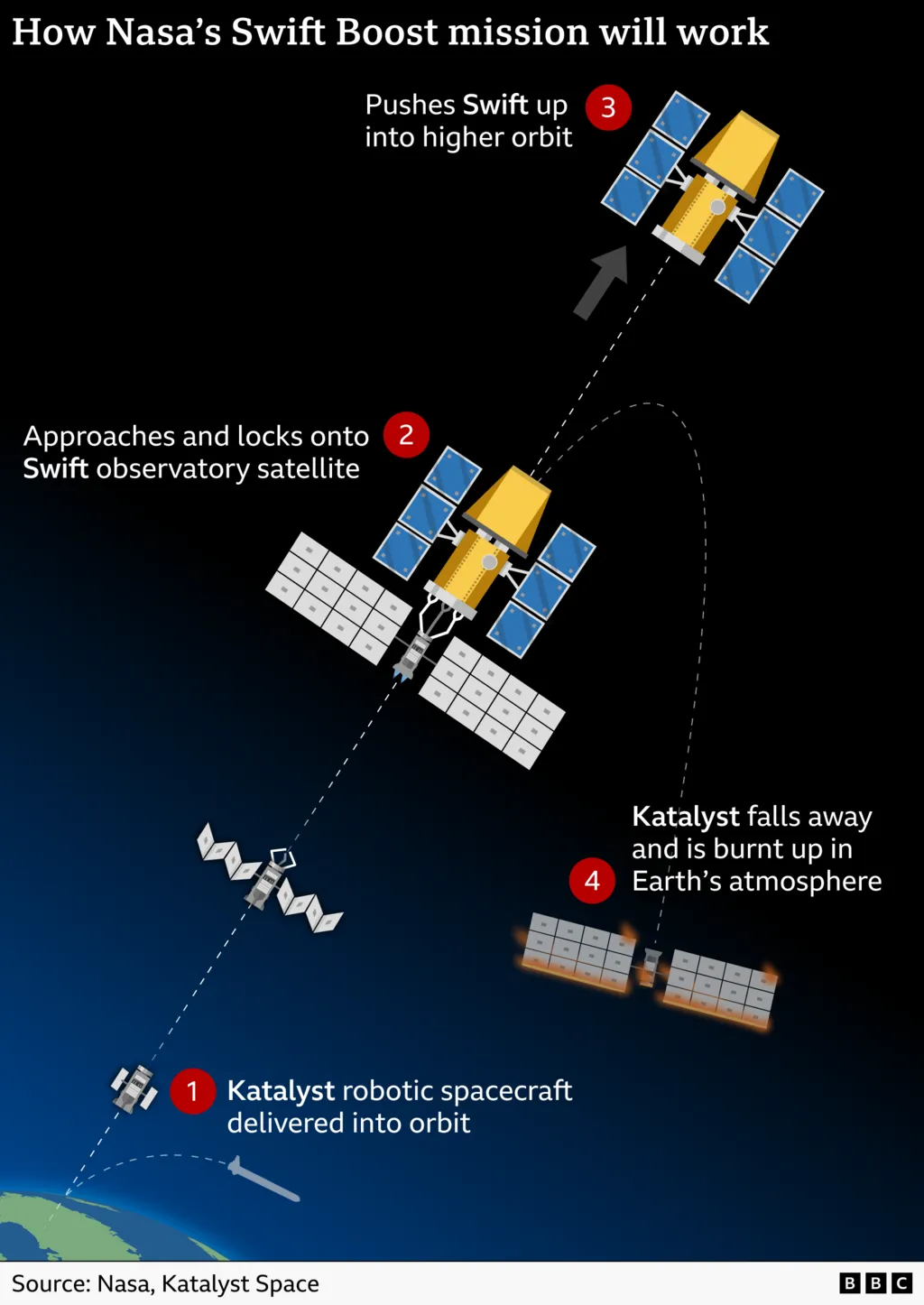
- The Survey Phase (2-3 Weeks): LINK will carefully approach Swift and spend weeks mapping it using sensors to find the safest point to latch onto.
- The Robotic Grapple: LINK will deploy three innovative robotic arms to manually clamp onto a static launch flange on the base of Swift.
- The Ion Push: Once securely attached, LINK will ignite high-efficiency, low-power ion thrusters. Over the course of 10 to 12 weeks, it will gently nudge the combined spacecraft up to a safe orbit of roughly 370 miles (600 km).
Why This Mission Changes Everything
The Swift Reboost Mission is far more than just a repair job. It represents a paradigm shift in how humanity manages assets in Low Earth Orbit (LEO):
1. Commercial Precedent
If fully successful, LINK will be the first commercial spacecraft in history to dock with an uncrewed government satellite that wasn't designed for servicing.
2. Massive Cost Savings
At just $30 million, the reboost mission extends a highly functional telescope's lifespan by another 10 years, bypassing the immense cost of designing a replacement.
3. In-Space Logistics
Following the cancellation of NASA's internal OSAM-1 mission, this project validates a thriving commercial "tow truck" industry capable of cleaning space debris.
What's Next?
As of today, Swift remains in a temporary "low-drag configuration" to buy the mission extra time, with its solar panels intentionally misaligned from the sun to slice cleanly through the thin upper air. Over the next month, all eyes will be on Katalyst Space Technologies as LINK performs its system checks and slowly closes the distance to its historic target.
If they succeed, science will continue to peer into the deepest secrets of cosmic black holes—and space exploration will enter an entirely new era of sustainability.
Comments
Post a Comment